
Coming Home to the Present Moment: A Guide to Mindfulness and Relational Mindfulness
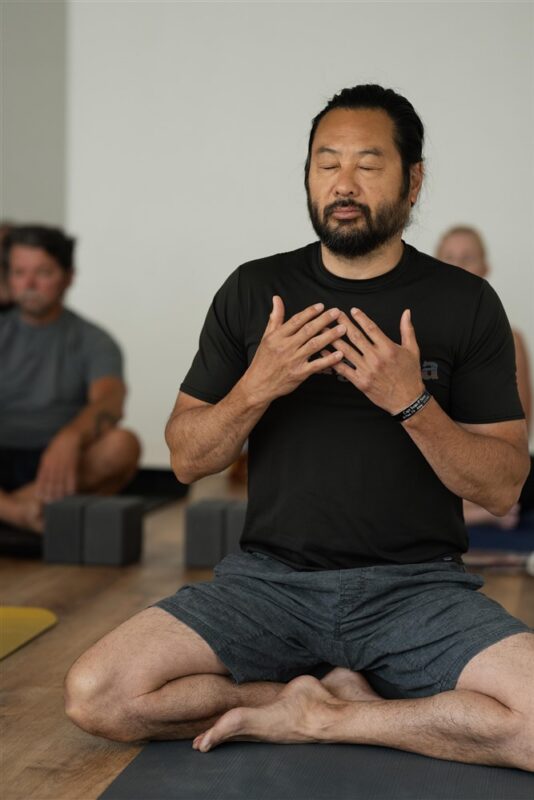
There’s a moment in almost every yoga class where something shifts. Maybe it’s during savasana, maybe it’s mid-flow when your breath finally catches up with your movement. In that moment, the to-do list quiets down and you’re simply here. That’s mindfulness — and it’s available to you far beyond the edges of your mat.
What Mindfulness Actually Is
Mindfulness is the practice of paying attention, on purpose, to what’s happening right now — without rushing to judge it, fix it, or turn away from it. It sounds simple. It is simple. But simple isn’t always easy.
Most of us move through our days on autopilot, half-present for our meals, our commutes, even our conversations. Our minds are busy rehearsing the past or auditioning the future. Mindfulness is the practice of interrupting that pattern, gently, again and again, and returning to now.
This isn’t about achieving a blank mind or permanent calm. Thoughts will still come. Emotions will still rise. Mindfulness simply changes your relationship to them — you notice them with curiosity instead of getting swept away.
How to Practice Mindfulness
You don’t need a silent retreat or a perfect meditation cushion to begin. Mindfulness is built in small, repeatable moments.
1. Start with the breath. Your breath is always available and always happening now. Try this: inhale for a count of four, hold for four, exhale for six. Notice the air moving in and out. When your mind wanders — and it will — simply notice that, and come back to the breath. That noticing is the practice, not a failure of it.
2. Anchor into the body. A body scan is one of the most accessible ways to arrive in the present. Starting at your feet and moving slowly upward, notice sensation without trying to change anything. Where is there tension? Where is there ease? This is often where mindfulness meets yoga most directly — every pose becomes an opportunity to ask, “What’s actually here right now?”
3. Use your senses as a doorway. When your thoughts are loud, your senses can bring you back quickly. Notice five things you can see, four you can hear, three you can feel. This isn’t a trick to escape your emotions — it’s a way to steady yourself enough to meet them.
4. Practice single-tasking. Choose one ordinary activity today — drinking your tea, washing dishes, walking to your car — and give it your full attention. Notice the temperature, the texture, the sound. This trains the same mental muscle as formal meditation, just woven into daily life.
5. Let go of the goal. The moment mindfulness becomes another thing to achieve or perfect, it stops working the way it’s meant to. There’s no finish line. There’s just the next breath, the next moment, the next chance to return.
Relational Mindfulness: Bringing Presence to Our Connections
Here’s something that doesn’t get talked about enough in yoga spaces: mindfulness isn’t only an inward practice. Some of the most meaningful — and most challenging — mindfulness work happens between people.
Relational mindfulness is the practice of bringing that same quality of attention, curiosity, and non-judgment to our relationships. It’s noticing what happens in your body when a conversation gets tense. It’s staying present with a partner, a friend, or a family member instead of mentally drafting your response while they’re still speaking. It’s the difference between listening to respond and listening to understand.
In my own work supporting couples and individuals, I’ve seen how often disconnection isn’t about a lack of love — it’s about a lack of presence. We’re physically in the room, but our nervous systems are somewhere else entirely: bracing, defending, planning our next point. Relational mindfulness asks us to notice that pattern and, gently, come back to the person in front of us.
A few ways to practice relational mindfulness:
- Pause before responding. Even a single breath between someone finishing their sentence and you beginning yours can change the entire tone of a conversation.
- Notice your body during connection. Tightness in your chest, a clenched jaw, a held breath — these are often the first signs that you’ve left the present moment and moved into old, protective patterns.
- Get curious instead of certain. Ask yourself, “What might I be missing here?” rather than assuming you already know what the other person means or feels.
- Practice eye contact and stillness. Simply being fully present with someone — no phone, no rehearsing, no fixing — is one of the most generous things we can offer another person.
- Bring self-compassion into the room. You cannot be present with someone else while being at war with yourself. Relational mindfulness includes the relationship you have with your own inner experience, too.
Why This Matters On and Off the Mat
Yoga has always been about more than physical posture. It’s a practice of coming home — to your breath, your body, and ultimately, to your relationships. The steadiness you build on your mat, breath by breath, is the same steadiness you can bring to a hard conversation with someone you love.
Mindfulness isn’t a destination you arrive at and stay. It’s a practice of returning, over and over, with patience and without judgment. Some days that return will feel easy. Other days it won’t. Both are part of the path.
We’d love to have you join us at Tuladhara Yoga — on the mat, in community, and in the ongoing practice of coming back to what’s real.