Why Props Aren’t a Shortcut: The Real Benefits of Using Them in Your Yoga Practice
Walk into almost any yoga class and you’ll spot them stacked along the wall: blocks, straps, bolsters, blankets, maybe a chair. For a lot of practitioners, there’s a quiet hesitation around reaching for them — a sense that using props means you’re not quite strong enough, flexible enough, or advanced enough to do the “real” pose.
Let’s put that idea to rest. Props aren’t training wheels. They’re tools — and skilled use of them is one of the clearest signs of an experienced, intelligent practice, not a beginner one.
Where the “Props Are a Crutch” Myth Comes From
Somewhere along the way, yoga culture absorbed the idea that the deepest, most “authentic” expression of a pose is the one done with nothing but your own body. Props got coded as remedial — something you graduate out of once you’re good enough.
But that idea has it backwards. Props were never designed to help you fake a pose you can’t do. They were designed to help you access the actual intention of a pose — proper alignment, breath, and sustainable effort — regardless of your body’s shape, size, flexibility, injuries, or experience level. Using them well takes more body awareness, not less.
The Real Benefits of Practicing with Props
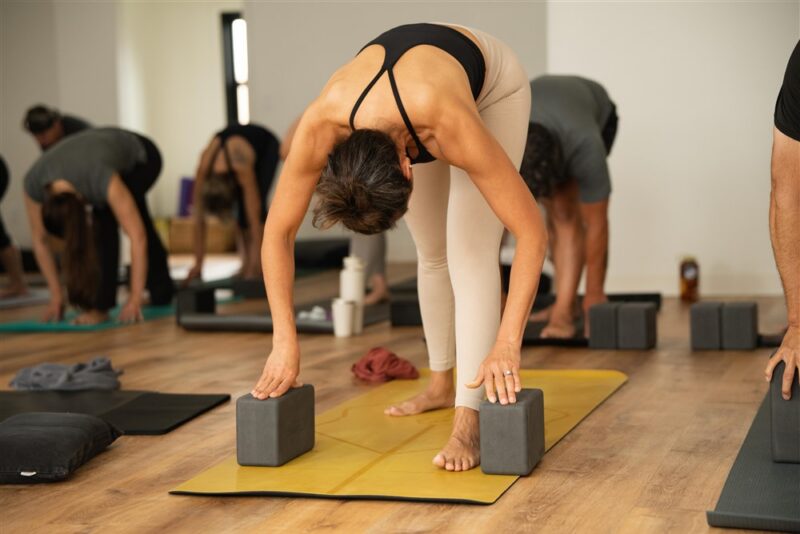
1. They meet your body where it actually is. No two bodies are built the same. Differences in limb length, joint structure, past injuries, and years of life experience mean the “textbook” version of a pose isn’t equally accessible to everyone — and it was never meant to be. A block under the hand in triangle pose, for example, isn’t a workaround. It’s what allows your specific body to find the same length through the spine and the same integrity in the pose that someone with longer arms might find without it.
2. They protect your joints. Props help distribute weight and reduce unnecessary strain on knees, wrists, shoulders, and the lower back. A folded blanket under the knees in a kneeling pose, or a block under the hips in a seated forward fold, can be the difference between a pose that serves your body and one that quietly wears it down over time.
3. They deepen — not diminish — the stretch or hold. This is especially true in restorative and yin practices, where props fully support the body so muscles can release completely, or so a pose can be held long enough for connective tissue and fascia to actually respond. Without support, many of these poses simply can’t be held long enough to create the benefit they’re designed for.
4. They build genuine strength and alignment, not compensation. Ironically, skipping props often means compensating — rounding the spine to reach the floor, gripping with the wrong muscles, holding your breath to power through. Using a prop to maintain correct alignment builds the right muscles in the right way, which is what actually creates strength and mobility over time.
5. They make the practice more sustainable. A pose you can only access by straining or bracing isn’t one you can stay in for long, physically or mentally. Props allow you to hold poses longer, breathe more fully, and stay present, rather than gritting your way through discomfort that pulls your attention away from the practice itself.
6. They support the mental and emotional side of yoga, too. Especially in slower practices, props create a felt sense of safety and support in the body. That physical support often translates into a nervous system that can finally soften — which is, in many ways, the whole point.
7. They make yoga more inclusive. Props open the practice to people managing injuries, chronic pain, pregnancy, aging bodies, or simply different anatomy than the person on the next mat. A studio that normalizes props is a studio where more bodies genuinely belong.
A Different Way to Think About Reaching for a Block
Next time you’re in class and your teacher offers a prop, try reframing the moment. Reaching for a block isn’t an admission that you can’t do the pose — it’s a decision to do the pose well, in the body you actually have today. That’s not a lesser practice. It’s often a wiser one.
The most experienced yogis in the room are rarely the ones avoiding props. They’re the ones who’ve learned to use them with intention, because they understand that support and strength were never opposites in the first place.
Come try a class at Tuladhara Yoga — we keep the props close by, and we mean it when we say every body is welcome exactly as it is.